
We stand at the precipice of a technological shift that mirrors the arrival of electricity or the internet. Artificial Intelligence (AI) has already moved out of science fiction novels and into our pockets, homes, and workplaces. But what we see today—voice assistants that sometimes misunderstand us or recommendation algorithms that know our shopping habits—is merely the opening act.
The future of AI in everyday life promises a profound transformation. It isn’t just about robots taking over mundane tasks; it’s about a fundamental reshaping of how we learn, heal, travel, and entertain ourselves. This article explores the trajectory of AI integration across five key pillars of daily existence and examines the ethical hurdles we must clear along the way.
Healthcare: From Reactive to Predictive
Perhaps the most impactful changes will occur in how we manage our health. Today, healthcare is largely reactive; you get sick, you see a doctor, and you get treated. The future of AI promises a shift to predictive and personalized medicine.
The Rise of the Digital Twin
Imagine having a digital replica of your own biology. Researchers are developing “digital twins”—virtual models of human organs or entire physiological systems. Doctors could test drugs on your digital twin to predict side effects before prescribing them to you. This level of personalization will drastically reduce adverse drug reactions and improve treatment efficacy.
AI as the First Line of Diagnosis
Wearable technology is evolving beyond counting steps. Future devices will monitor glucose levels, heart rate variability, and blood oxygen continuously. AI algorithms will analyze this stream of data to detect anomalies days or weeks before symptoms appear. You might receive a notification suggesting you hydrate and rest because your biometrics indicate a flu is developing, or an alert to see a cardiologist because of an irregular rhythm detected during sleep.
Enhanced Surgical Precision
Robotic surgery is already here, but AI will take it further. Autonomous surgical robots, supervised by human surgeons, will perform delicate procedures with a steadiness and precision no human hand can match. These systems will use real-time data analysis during surgery to avoid critical blood vessels and nerves, leading to faster recovery times and safer outcomes.
Education: The End of the “One Size Fits All” Model
The traditional classroom model, where one teacher instructs thirty students at the same pace, is ripe for disruption. AI offers the possibility of hyper-personalized education that adapts to the unique learning style of every student.
Adaptive Learning Platforms
Future AI tutors won’t just grade multiple-choice tests; they will understand how a student learns. If a student struggles with quadratic equations, the AI won’t just repeat the lesson. It might switch strategies, offering a visual explanation instead of a textual one, or gamifying the problem. This ensures that fast learners aren’t bored and those who need more time aren’t left behind.
Lifelong Learning Companions
In a rapidly changing job market, education won’t stop at graduation. AI-driven platforms will serve as lifelong career coaches. They will analyze job market trends and identify gaps in your skill set, recommending specific micro-courses to keep you employable. Whether you are 25 or 55, your AI companion will guide your professional development, suggesting a new coding language or a soft-skills workshop based on your career trajectory.
Transportation: Beyond the Driverless Car
Autonomous vehicles (AVs) are the poster child for AI innovation, but the future of transportation involves a broader ecosystem of intelligent mobility.
The Connected Traffic Grid
The true power of AI in transportation lies in connectivity. Future traffic lights, road sensors, and vehicles will communicate in real-time. An ambulance approaching an intersection won’t just rely on sirens; it will digitally communicate with the traffic grid to turn lights green, clearing a path instantly. For the daily commuter, this means optimized traffic flows that could virtually eliminate rush-hour congestion in major cities.
Mobility as a Service (MaaS)
Ownership models are likely to change. Instead of owning a car that sits parked 95% of the time, AI will facilitate seamless “Mobility as a Service.” You might subscribe to a transportation tier. When you need to go to work, a small autonomous pod picks you up. For a weekend trip, a larger SUV arrives. AI fleet management will ensure these vehicles are routed efficiently, reducing the total number of cars on the road and lowering emissions.
Home Automation: The Truly Smart Home
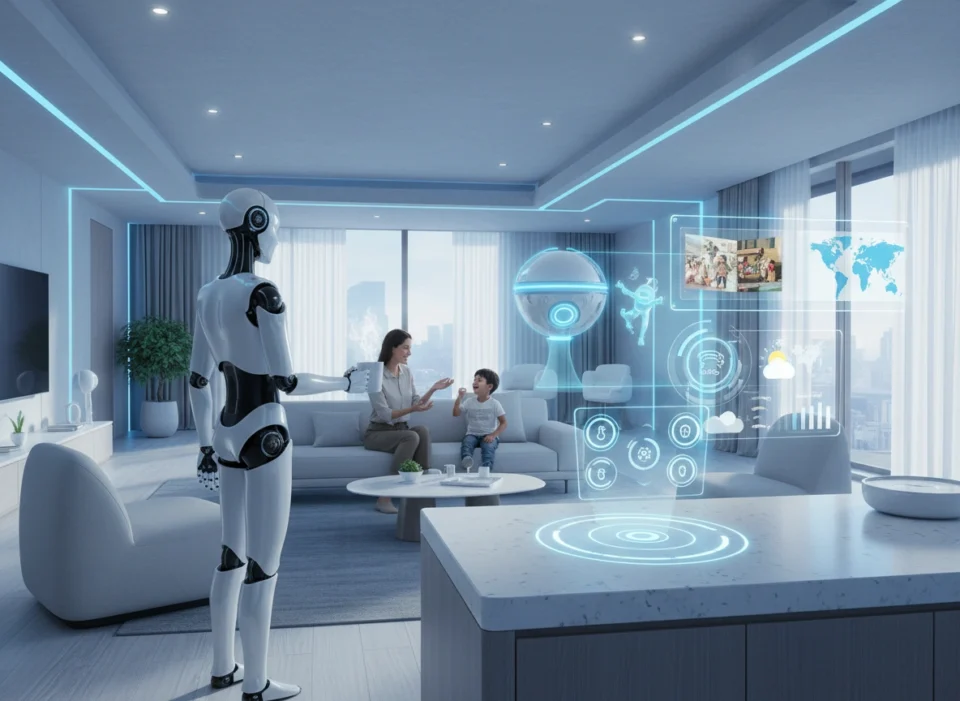
Current smart homes are essentially remote-controlled homes. You still have to tell the lights to turn off or the thermostat to adjust. The future AI home will be proactive and context-aware.
Context-Aware Living
Your home will learn your routine and anticipate your needs. If you start a movie, the house will automatically dim the lights and lower the blinds without a voice command. If you wake up in the middle of the night, the hallway lights will glow softly to guide you without blinding you.
Beyond convenience, these systems will optimize energy usage. The AI will learn the thermal properties of your house—how quickly it heats up or cools down—and adjust the HVAC system to use the least amount of energy while maintaining your preferred comfort levels, potentially saving significantly on utility bills.
The Kitchen Assistant
Smart fridges are often mocked, but their future iteration will be genuinely useful. Advanced computer vision will track the ingredients you have and their expiration dates. Based on what is in your pantry, the AI will suggest recipes to minimize food waste. It might even interface with your grocery delivery service to auto-replenish staples like milk and eggs before you run out.
Entertainment: Personalized and Immersive
The entertainment industry is already heavily reliant on recommendation algorithms, but the future holds content that is not just recommended for you, but created for you.
Generative Content
We are seeing the early stages of this with AI art and text generators. In the future, AI could generate video games or movie scenes on the fly tailored to your preferences. Imagine a video game where the dialogue, plot twists, and difficulty adjust dynamically based on your reactions and play style.
Immersive Virtual Worlds
AI will populate the Metaverse or virtual reality spaces with realistic non-player characters (NPCs). These virtual beings will hold natural conversations, remember past interactions, and display complex emotions, making virtual worlds feel indistinguishable from social reality. This level of immersion will redefine gaming, social interaction, and even remote work collaboration.
The Ethical Landscape: Navigating the Challenges
While the benefits are dazzling, the integration of AI into everyday life brings significant ethical and societal challenges that we must address proactively.
Data Privacy and Security
For AI to be truly useful, it needs data—your health records, your location history, your voice commands. The more the AI knows, the better it serves you, but the greater the privacy risk. We need robust frameworks to ensure that this data is encrypted, anonymized, and that users retain ownership of their digital footprint. A breach in a system that controls your home security or holds your genetic data is far more dangerous than a stolen credit card number.
Algorithmic Bias
AI systems learn from human data, and human data contains human biases. If a hiring algorithm is trained on historical data where men were predominantly chosen for leadership roles, the AI may learn to penalize female candidates. Ensuring fairness requires rigorous auditing of algorithms and diverse datasets to prevent AI from automating discrimination in housing, lending, and employment.
The Human Connection
As AI takes over caregiving roles or educational tasks, we risk losing the human touch. A robot can remind an elderly person to take medication, but can it offer genuine empathy? We must design AI to augment human interaction, not replace it. The goal should be to use AI to handle administrative burdens so that doctors, teachers, and caregivers have more time for face-to-face connection, not less.
Conclusion: A Collaborative Future
The future of Artificial Intelligence in everyday life is not a distant dream; it is a rapidly unfolding reality. From predictive healthcare that saves lives to adaptive education that unlocks potential, the possibilities are limitless. However, technology is a tool, not a destiny. The shape of this future depends on the choices we make today regarding regulation, ethics, and design.
We must embrace these advancements with a critical eye, ensuring that as machines become more intelligent, our use of them becomes more wise. By addressing the challenges of privacy and bias head-on, we can build a future where AI serves as a silent, efficient partner in a life that remains distinctly and beautifully human.
Please visit website for more info.
