
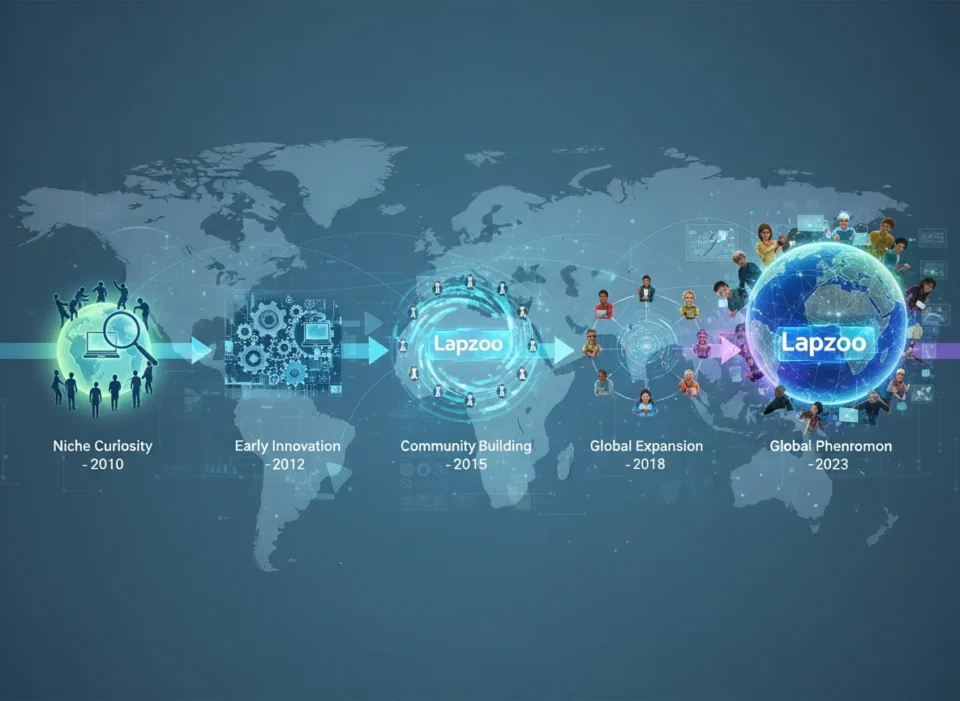
The trajectory of technological and cultural evolution is often marked by sudden, unexpected leaps. While many innovations follow a predictable path of gradual improvement, others seem to emerge almost fully formed, reshaping industries and user behaviors in their wake. Lapzoo stands as a singular example of the latter. What began as an experimental interface protocol has transformed over decades into a comprehensive ecosystem that touches nearly every aspect of modern digital interaction.
To understand the current dominance of Lapzoo, one must look beyond its sleek modern interface and examine the turbulent, innovative, and often controversial history that forged it. This article explores the origins of Lapzoo, traces its pivotal milestones, and analyzes how it evolved from a fragmented concept into the unified standard we recognize today.
Origins: The “Zoo” Protocol (1998-2003)
The story of Lapzoo begins not in a Silicon Valley garage, but in the academic halls of the University of Helsinki in the late 1990s. Dr. Elena Vance and her team of graduate researchers were grappling with a specific problem: data fragmentation across heterogeneous networks. At the time, transferring complex data sets between distinct operating environments resulted in significant packet loss and corruption.
Vance proposed a radical solution. Instead of trying to force compatibility between rigid systems, she theorized a “living” wrapper for data—a meta-layer that could adapt its structure based on the environment it entered. Because the code behaved with a level of autonomy and adaptability reminiscent of biological organisms, the team colloquially referred to the containment environment as the “Zoo.”
The early “Zoo Protocol” was raw and difficult to manage. It required immense computational overhead, making it impractical for consumer hardware of the era. However, the core concept—data that carries its own instructional logic—was revolutionary. In 2001, Vance published the seminal paper “Adaptive Logic in Static Environments,” which laid the theoretical groundwork for what would become Lapzoo.
While the academic community applauded the theory, commercial application remained elusive. The dot-com crash of the early 2000s dried up funding for experimental architecture, and the Zoo Protocol was shelved, existing only as obscure code in university repositories.
The LAP Integration and Rebirth (2004-2009)
The resurrection of the project came from an unlikely source: the logistics industry. By the mid-2000s, global supply chains were becoming increasingly digitized, yet they suffered from the same interoperability issues Vance had identified years earlier. Enter Marcus Thorne, a systems architect for a major shipping conglomerate. Thorne stumbled upon Vance’s research while looking for ways to track perishable goods across different tracking systems.
Thorne realized that the Zoo Protocol’s “heavy” computational requirements were no longer a barrier thanks to the rapid advancement of processing power (Moore’s Law). He proposed combining the adaptive nature of the Zoo Protocol with a Lightweight Access Protocol (LAP). The LAP would serve as the efficient, fast-moving carrier, while the Zoo component would handle the complex data integrity.
The hybrid system was dubbed “Lapzoo.”
The first official deployment occurred in 2007. It was an internal tool used solely for high-value logistics tracking. The results were staggering. Data corruption dropped to near zero, and system handshakes that previously took minutes were executed in milliseconds.
Recognizing the potential beyond logistics, Thorne and Vance formed a partnership. In 2009, they founded Lapzoo Systems, taking the technology private. Their goal was ambitious: to move Lapzoo out of the warehouse and into the consumer software market.
The Consumer Shift and the “Wild Era” (2010-2015)
The early 2010s marked the “Wild Era” of Lapzoo. The company released the Lapzoo SDK (Software Development Kit) to the public in 2010, allowing third-party developers to build applications on top of the Lapzoo architecture.
This period was characterized by explosive, often chaotic growth. Developers fell in love with Lapzoo’s “elasticity.” Unlike traditional coding environments where parameters had to be strictly defined, Lapzoo allowed for “fuzzy logic” inputs. This was particularly useful for the burgeoning mobile app market, where device specifications varied wildly.
However, this freedom came with costs. The years 2011 to 2013 saw major security vulnerabilities. Because Lapzoo packets (“animals,” as the community called them) were self-executing, malicious actors found ways to embed viral payloads within them. The “Z-Day” exploit of 2012 was a particularly low point, crashing servers across three continents and compromising millions of user accounts.
Critics declared the platform dead. Tech editorials argued that the very adaptability of Lapzoo was its fatal flaw. But the company’s response defined its future. Instead of locking down the system, they introduced the “Keeper” framework—an AI-driven oversight layer that verified the intent of code packets without restricting their adaptability.
This pivot to AI-moderated security was years ahead of its time. By 2015, Lapzoo had not only recovered its reputation but had become the gold standard for secure, cross-platform development.
Standardization and Enterprise Adoption (2016-2020)
With security concerns largely mitigated, the corporate world began to pay attention. The shift toward cloud computing and microservices architecture played directly into Lapzoo’s strengths. Enterprises needed systems that could speak to one another seamlessly, regardless of whether they were hosted on AWS, Azure, or private servers.
In 2017, Lapzoo introduced “Lapzoo Enterprise Core.” This was no longer just a protocol; it was a full-stack operating environment. Major financial institutions adopted it for real-time trading platforms, valuing the micro-latency advantages. Healthcare providers utilized it to unify disparate patient record systems securely.
Key milestones during this period included:
- 2016: The acquisition of StreamLine, which integrated real-time media processing into Lapzoo, making it a favorite for streaming services.
- 2018: The “Universal Bridge” update, allowing Lapzoo to interface natively with legacy systems from the 1990s, saving corporations billions in upgrade costs.
- 2019: Lapzoo Systems went public in one of the decade’s most anticipated IPOs.
This era solidified Lapzoo not as an experimental tool, but as vital infrastructure. It became the “plumbing” of the modern internet—essential, reliable, and largely invisible to the end-user.
The Modern Era: AI Integration and The Neural Web (2021-Present)
Today, Lapzoo stands at the forefront of the artificial intelligence revolution. The original vision of Dr. Vance—code that behaves like a living organism—has found its ultimate expression in the age of generative AI.
Modern Large Language Models (LLMs) and neural networks require massive data throughput and dynamic structural adjustments during training and inference. Traditional rigid protocols struggle with the fluidity required by neural computing. Lapzoo, with its inherent adaptability, was the missing puzzle piece.
In 2023, the release of Lapzoo 5.0 introduced “Neural Binding.” This feature allows AI models to modify the Lapzoo architecture in real-time to optimize their own performance. Essentially, the software rewrites itself to accommodate the AI’s needs moment to moment.
This capability has made Lapzoo the backbone of the next generation of computing. From autonomous vehicle networks communicating in real-time to smart cities managing energy grids, Lapzoo provides the flexible connective tissue that makes these complex systems viable.
Notable Figures and Cultural Impact
Throughout its history, several key figures have shaped Lapzoo’s ethos:
- Dr. Elena Vance: The “Mother of the Zoo,” whose insistence on biological mimicry in code remains the project’s philosophical core. She remains an active advisor and vocal advocate for ethical coding practices.
- Marcus Thorne: The pragmatist who bridged the gap between theory and industry. His focus on “boring” utility over flashy features ensured the company survived the dot-com volatility.
- Sarah Jenkins: The current CEO, who spearheaded the pivot toward AI integration. Jenkins is often credited with transforming Lapzoo from a backend utility into a consumer-facing brand.
Culturally, Lapzoo has even entered the lexicon. To “Zoo it” is common developer shorthand for finding a flexible workaround to a rigid problem. The visual language of the interface—distinctive for its organic, node-based visualizations—has influenced UI design trends across the industry, moving away from rigid grids toward fluid, dynamic layouts.
Challenges and Future Outlook
Despite its success, Lapzoo faces significant hurdles. The “Black Box” problem remains a concern. Because the system optimizes itself dynamically, even its creators sometimes struggle to explain how a specific process was executed. In sectors requiring strict audit trails, like law and banking, this opacity is a hurdle.
Furthermore, the sheer dominance of Lapzoo has raised antitrust concerns. With so much of the world’s digital infrastructure relying on a single proprietary standard, regulators in the EU and US are scrutinizing the company’s market power.
Looking forward, the roadmap for Lapzoo includes expansion into quantum computing. The “Q-Zoo” initiative aims to create the first standardized protocol for quantum data transmission. If successful, this could once again revolutionize the industry, much like the original LAP integration did twenty years ago.
Conclusion
The evolution of Lapzoo is a testament to the power of adaptability. It survived because it did not try to force the world to conform to its rules; instead, it built a system designed to conform to the world. From a theoretical exercise in a Finnish university to the neural backbone of the global economy, Lapzoo illustrates that in the digital ecosystem, as in the natural one, survival belongs not to the strongest, but to the most adaptable. As we move deeper into the age of AI and quantum computing, Lapzoo remains uniquely positioned to facilitate the next great leap in human technological capability.
