
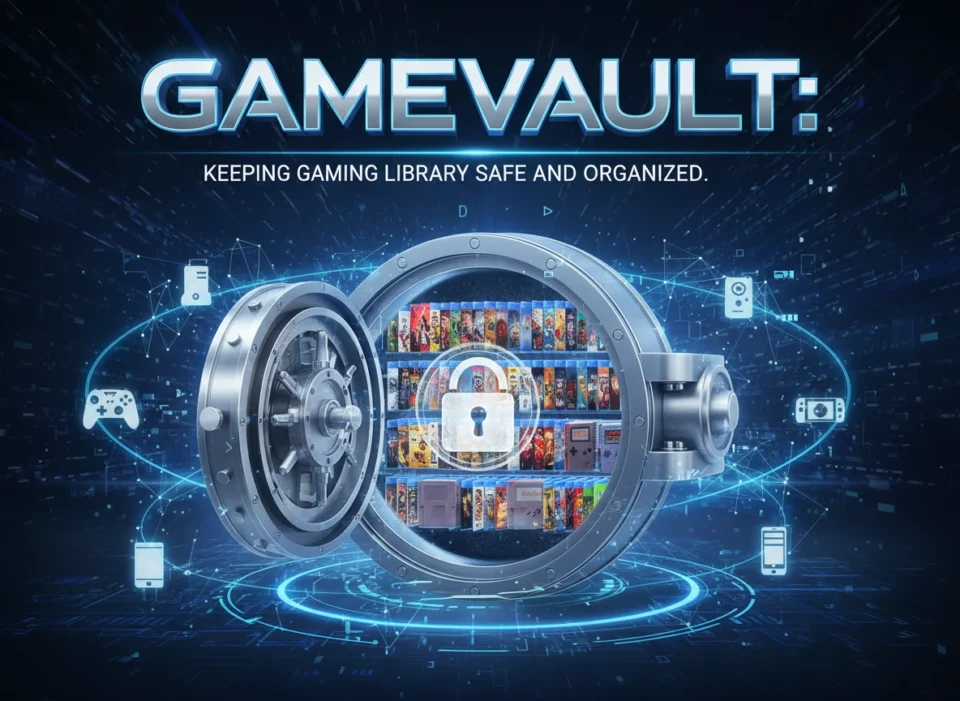
Digital game collections grow larger every year. As you accumulate hundreds of titles across various platforms, managing and protecting those files becomes a significant challenge. You might find yourself digging through messy hard drives, losing track of DRM-free installers, or worrying about losing access to games if a storefront closes its doors.
Enter Gamevault. Gamevault serves as a self-hosted platform designed specifically to manage, organize, and secure your personal gaming library. It acts much like a private streaming service, but for your video games.
In this article, we will explore exactly how Gamevault works. You will learn about its security features, its powerful organizational tools, the tangible benefits it offers to dedicated gamers, and real-world scenarios where it truly shines.
What is Gamevault?
Gamevault is a self-hosted platform that allows you to store, organize, and access your video games from a central server. Built primarily for DRM-free games, ROMs, and independent titles, it gives you complete ownership over your digital library. Instead of relying on a third-party client that requires a constant internet connection, Gamevault runs on your own hardware.
The purpose of Gamevault is simple: to give gamers a unified, beautiful, and secure environment to track and play their collections. You host the backend server on a NAS (Network Attached Storage) or an old PC, and use the Gamevault client on your gaming machine to browse, download, and launch your games. It puts the power back in your hands, ensuring that the games you buy remain yours forever.
How Gamevault Ensures Safety and Security
When you invest time and money into a digital game collection, security and preservation are paramount. Gamevault offers several robust features to keep your library safe.
Complete Data Ownership and Privacy
Because Gamevault is self-hosted, your data never leaves your home network unless you explicitly set it up to do so. You do not have to worry about a corporate server tracking your playtime, scanning your files, or selling your data. Your library resides entirely on your own hard drives. This local approach provides an impenetrable layer of privacy that cloud-based services simply cannot match.
Protection Against Storefront Closures
We have all seen digital storefronts shut down, taking users’ purchased games down with them. By using Gamevault to store your DRM-free installers and game files, you create a permanent archive. Even if a publisher pulls a game from distribution, your copy remains safe and playable on your server.
User Management and Access Control
If you share a household with other gamers or children, Gamevault allows you to create individual user accounts. You can set permissions, restrict access to certain mature titles, and keep your personal save files separate. This ensures that your carefully curated library cannot be accidentally deleted or modified by unauthorized users.
Secure Backup Potential
Gamevault pairs perfectly with standard data backup practices. Because all your game files sit neatly in a centralized directory on your server, you can easily implement automated backups. Whether you use RAID configurations on your NAS or back up your Gamevault directory to an external drive, you dramatically reduce the risk of data loss from hardware failure.
Powerful Organizational Tools
A large gaming library is useless if you cannot find the game you want to play. Gamevault excels at turning a chaotic folder of files into a sleek, highly searchable catalog.
Automated Metadata Scraping
You do not have to manually enter game titles, upload cover art, or type out descriptions. Gamevault automatically pulls rich metadata from IGDB (Internet Game Database). When you add a new game file to your server, Gamevault fetches the official cover art, background images, release dates, genre tags, and developer information. Your library instantly transforms into a visually stunning gallery.
Advanced Filtering and Tagging
Gamevault features a robust tagging system. You can filter your massive collection by genre, release year, developer, or custom tags. If you want to find an offline co-op game released before 2010, you can apply those specific filters and see the results instantly. This eliminates the endless scrolling associated with large, unorganized directories.
Tracking Playtime and Progress
The platform includes built-in tracking features that log your playtime and game progress. You can mark games as “Playing,” “Completed,” or “On Hold.” This helps you manage your backlog effectively. You always know exactly where you left off and which games you have conquered.
Unified Cross-Platform Library
Many gamers own titles spanning decades of gaming history, from retro console ROMs to modern indie releases. Gamevault brings all these disparate file types under one roof. Instead of juggling five different emulation front-ends and PC game launchers, you access your entire gaming history through one clean interface.
The Tangible Benefits for Gamers
Using Gamevault provides several distinct advantages that improve your overall gaming experience.
Free Up Local Disk Space
Modern PC games demand massive amounts of storage space. By keeping your entire repository on a dedicated Gamevault server, you free up precious SSD space on your primary gaming rig. You simply download the specific game you want to play right now through the Gamevault client, play it, and uninstall it when you finish, knowing the installer is safely waiting on your server.
True Offline Accessibility
Internet outages happen. When they do, many modern game launchers refuse to let you access your single-player games. Because Gamevault operates entirely on your local area network (LAN), your internet connection status does not matter. You can browse your library and launch your games completely offline.
Preserving Gaming History
Game preservation is a critical topic in the gaming community. Gamevault empowers individuals to act as their own archivists. By organizing and securing legacy titles, fan translations, and rare indie games, you contribute to keeping gaming history alive and accessible for future generations.
Real-World Scenarios Where Gamevault Shines
To understand the practical value of Gamevault, let us look at a few common scenarios where it solves real problems for gamers.
Scenario 1: The Disorganized Collector
Imagine a gamer who has been buying DRM-free games from GOG and indie bundles for ten years. Their downloads folder contains thousands of poorly named zip files, installers, and patches. Finding a specific game takes twenty minutes of searching.
By pointing Gamevault at this chaotic directory, the software instantly parses the files, matches them with IGDB, and presents a beautiful visual library. The gamer can now browse by cover art and genre, turning a digital junk drawer into a private gaming museum.
Scenario 2: The Multi-Device Household
Consider a family with a gaming desktop in the office, a gaming laptop for the living room, and a handheld PC like a Steam Deck. Syncing game installers across all these devices manually is a nightmare.
With Gamevault installed on a central home server, any device on the network can run the Gamevault client. The user can pull down an installer to the desktop, or download a retro title straight to their handheld, all from the exact same centralized source.
Scenario 3: The DRM-Free Archiver
A dedicated gamer worries about the shifting landscape of digital licensing. They purchase games, download the offline installers, and place them into Gamevault. When a major publisher announces that a classic game will be delisted from all storefronts due to expiring music licenses, this gamer does not panic. Their legal, DRM-free copy remains safe, organized, and ready to play on their Gamevault server.
Conclusion
Managing a growing digital game library requires more than just a large hard drive; it requires a dedicated system. Gamevault provides an elegant, robust solution for gamers who value ownership, security, and organization.
By offering self-hosted architecture, automated metadata scraping, and powerful cataloging tools, Gamevault ensures your games remain safe from storefront closures and hardware failures. It transforms messy file directories into beautiful, easily navigable libraries.
If you want to take control of your digital collection, protect your purchases, and streamline your gaming experience, setting up a Gamevault server is the perfect next step. Reclaim your digital library today and build the private gaming archive you deserve.
