
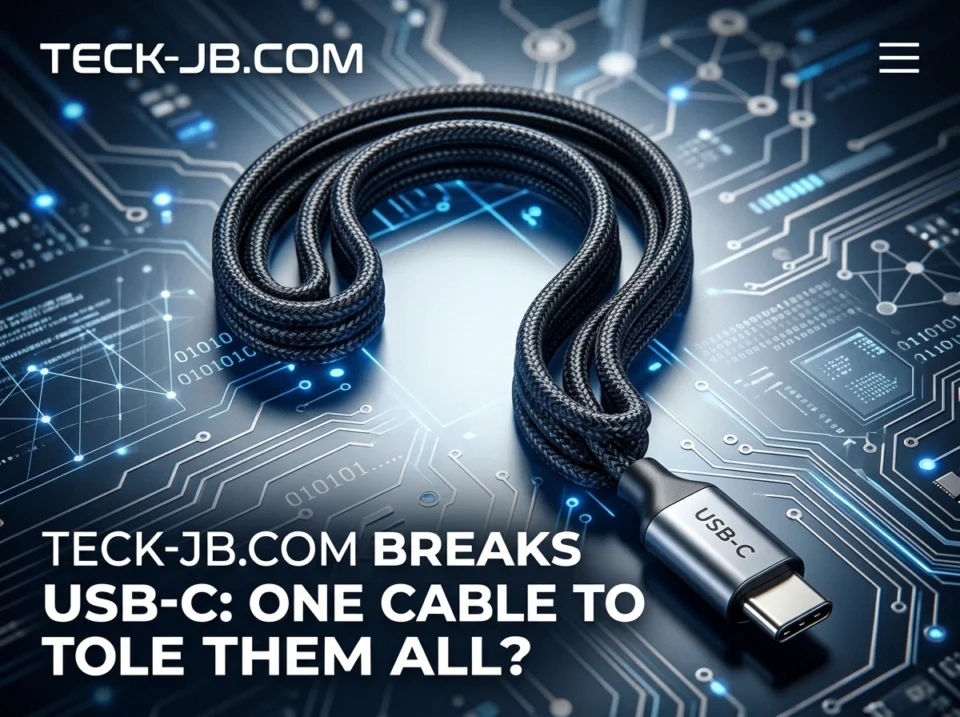
Look behind your TV, inside a junk drawer, or at the bottom of your bag. Chances are you’ll find a tangle of cables—each one slightly different, each one impossible to plug in on the first try. For decades, that was just life with electronics. Then USB-C showed up and promised to fix it all with a single, reversible connector.
But does USB-C actually live up to the hype? Is it really one cable to rule them all? The team at teck-jb.com takes a clear-eyed look at what USB-C is, how it works, and whether it deserves a permanent spot in your gear.
What Exactly Is USB-C?
USB-C is a connector standard. That small, oval-shaped plug you now see on phones, laptops, tablets, and game controllers? That’s USB-C. The biggest practical win is that it’s reversible. There’s no “wrong” side, so you can plug it in without flipping it three times in the dark.
The USB Implementers Forum (USB-IF), a group made up of major tech companies, introduced the USB-C connector in 2014. The goal was simple: replace the messy mix of ports with one universal shape that could handle power, data, and video all at once.
It’s worth clearing up one point early. USB-C describes the physical connector. The speed and features depend on the technology running through it, like USB 3.2, USB4, or Thunderbolt. Same plug, very different capabilities. We’ll come back to that.
A Quick History: How We Got Here
To appreciate USB-C, it helps to remember what came before.
USB-A
The classic rectangular USB plug launched in the late 1990s. It became the standard for everything from flash drives to keyboards. Reliable, but bulky and never reversible.
Micro-USB
For years, Micro-USB charged most Android phones and small gadgets. It was tiny and fragile, with a habit of wearing out and only fitting one way.
Lightning
Apple introduced its Lightning connector in 2012 for iPhones and iPads. It was reversible and compact, but it was proprietary, meaning Apple controlled it and other brands couldn’t use it freely.
USB-C arrived to unify these competing standards into one open design that any manufacturer could adopt. That open approach is a big reason it spread so fast.
How USB-C Differs From Older Connectors
The differences go well beyond shape. Here’s where USB-C pulls ahead.
- Reversible design: No more guessing which way is up.
- One port, many jobs: A single USB-C port can deliver power, move data, and output video.
- More power: USB-C supports far higher wattage than Micro-USB or USB-A ever could.
- Faster data: Depending on the standard, USB-C can transfer data at blistering speeds.
- Smaller footprint: Thin laptops and slim phones benefit from the compact size.
Older connectors usually did one thing well. USB-C aims to do nearly everything.
The Key Capabilities of USB-C
This is where USB-C really earns its reputation. Let’s break down what it can do.
Power Delivery
USB Power Delivery (USB PD) lets USB-C carry significant electrical power, up to 240 watts on the latest spec. That’s enough to charge not just phones, but full-size laptops and even some monitors.
It also works both ways. A laptop can charge a phone, or a power bank can charge a laptop. The cable negotiates how much power flows, which protects your devices.
Data Transfer Speeds
Speed depends on the underlying technology. Basic USB 2.0 over USB-C tops out at 480 Mbps. Step up to USB4 or Thunderbolt and you can hit 40 Gbps. That means transferring a large video file in seconds instead of minutes.
Video Output
Thanks to “Alternate Mode,” USB-C can carry video signals to monitors and TVs. One cable can power your laptop and drive an external 4K display at the same time. For anyone with a cluttered desk, that’s a real upgrade.
Compatibility
USB-C plays nicely with adapters. You can connect to HDMI, older USB-A devices, Ethernet, and SD cards using simple hubs. This flexibility makes it a practical bridge between old and new gear.
Why USB-C Matters for Consumers
For everyday users, the benefits are easy to feel.
- Fewer cables: One charger can handle your phone, laptop, headphones, and tablet.
- Faster charging: Top off your battery in less time.
- Less frustration: The reversible plug ends the flip-and-fail routine.
- Future-ready: New devices increasingly ship with USB-C by default.
There’s a regulatory angle too. The European Union now requires USB-C charging on many devices, including iPhones. That global pressure pushes more manufacturers worldwide to standardize, which benefits American shoppers through wider compatibility and lower long-term costs.
Why USB-C Matters for Businesses
Companies stand to gain just as much, maybe more.
Offices can standardize on a single cable type, cutting down on lost adapters and IT headaches. Conference rooms become simpler when one USB-C cable handles charging, display, and data. Reducing the number of proprietary chargers also supports sustainability goals, which matters to customers and shareholders alike.
For growing businesses planning tech upgrades, a USB-C-first strategy reduces waste and keeps equipment compatible across teams and locations.
Common Misconceptions About USB-C
USB-C is great, but a few myths cause real confusion.
“All USB-C cables are the same”
Not even close. Some cables only charge. Others handle high-speed data and video. A cheap cable might charge your phone slowly but fail to drive a monitor. Always check the specs.
“USB-C means fast charging”
The port helps, but speed also depends on the charger, the cable, and the device. Pairing a low-wattage charger with a power-hungry laptop won’t deliver fast results.
“If it fits, it works fully”
The connector may fit every USB-C device, but the features won’t always match. A Thunderbolt port and a basic USB-C port look identical yet perform very differently.
The takeaway: buy quality cables from trusted sources and read the labels.
The Future of USB-C as a Universal Standard
USB-C is closer to becoming a true universal standard than any connector before it. Regulations are pushing adoption. Major brands have embraced it. Newer standards like USB4 keep raising the ceiling on speed and power.
Still, “universal” comes with an asterisk. The shared shape is settled, but the range of capabilities behind that shape means consumers must stay a little informed. Clearer labeling from manufacturers would help close that gap.
The direction is clear, though. Over the next few years, expect USB-C to dominate phones, laptops, accessories, and beyond. Wireless charging may grow alongside it, but for wired connections, USB-C is the front-runner.
Final Thoughts
So, is USB-C one cable to rule them all? Mostly, yes. It unifies power, data, and video in a single reversible connector that’s open to every manufacturer. It simplifies life for consumers and streamlines operations for businesses.
The catch is that not every USB-C cable or port is equal. Knowing what you’re buying makes all the difference. Choose reliable cables, match them to your devices, and you’ll enjoy everything this versatile standard offers.
For more straightforward tech breakdowns and buying guidance, visit teck-jb.com and stay ahead of the curve. The one-cable future is nearly here, and with the right knowledge, you’re ready for it.
